 Skip to content


Dr. Felicity Thomas
Author

Dr. Carly Green
Editor
Parties to the United Nations Framework Convention on Climate Change are required to prepare and report national greenhouse gas (GHG) inventories that are accurate, consistent, complete and transparent. For Caribbean countries, strengthening agricultural GHG inventories is important not only for meeting international reporting requirements, but also for improving the evidence available for national agricultural and climate policy. More complete and reliable inventory information can help countries understand the principal sources of agricultural emissions, identify appropriate mitigation priorities, assess progress over time and strengthen the evidence base for access to climate finance and investment. It can also support the development of agricultural systems that are more productive, resilient and sustainable in the face of climate change.
The New Zealand Government’s Climate Smart Agriculture Initiative funded a regional programme led and coordinated through the Caribbean Cooperative Measurement, Reporting and Verification Hub (CCMRV Hub). The CCMRV Hub provides an established regional platform through which Caribbean countries can collaborate on GHG measurement, reporting and verification, access technical support, share experience and strengthen national climate-reporting systems.
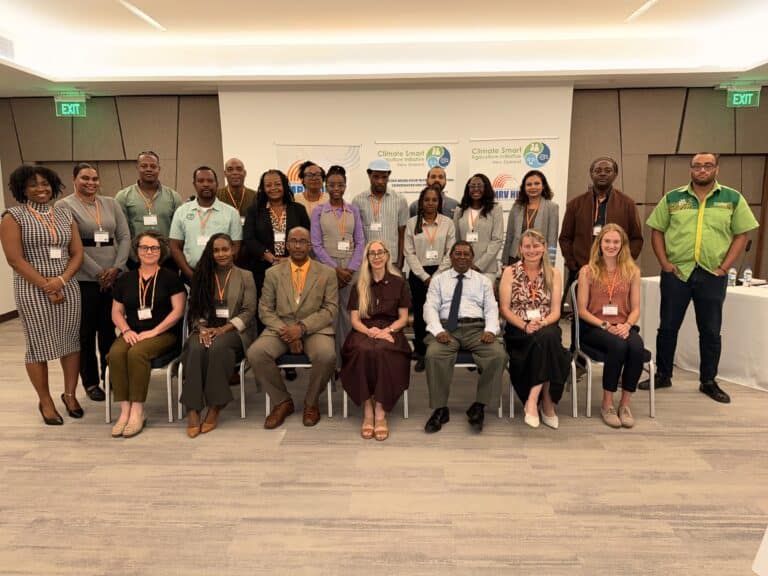
Through its relationships with participating countries and its regional coordination and technical leadership, the CCMRV Hub brought together agricultural GHG inventory practitioners from eight Caribbean countries. The programme was designed not only to strengthen individual country inventories, but also to build a regional network capable of supporting continued improvement, peer learning and consistency in agricultural GHG reporting beyond the period of formal project delivery.
This project was funded through the New Zealand Government’s Climate Smart Agriculture Initiative, as part of its contribution to the Global Research Alliance on Agricultural Greenhouse Gases (GRA). and managed by the New Zealand Ag Emissions Centre (AgEC).
The CCMRV Hub provided the regional leadership and institutional platform for the programme. It coordinated engagement with participating countries, helped ensure the training responded to regional and national priorities, supported collaboration among country teams and provided an ongoing mechanism through which the relationships, resources and technical capability developed under the project could continue to be used.
AgEC managed the New Zealand-supported programme and coordinated the international delivery team. EAS was engaged as a specialist technical delivery partner to provide workshops, online assistance, technical tools and peer review of country inventory reports.
EAS was subcontracted by AgEC as part of the team to deliver in-country workshops, provide online assistance to participants and undertake peer reviews of country inventory reports.
Project Objectives
The key objectives of the CCMRV Hub project were to:
- Build institutional capacity and capability to compile, manage and report robust national-level agricultural GHG inventories, with the aim of supporting a transition towards a combination of Tier 1 and Tier 2 methodologies for key agricultural emission sources across a historical time series.
- Support participating countries to use improved agricultural GHG inventories to meet UNFCCC reporting requirements, inform national agricultural and climate policy, identify mitigation priorities, consider access to climate finance, and plan resilient agricultural development.
- Strengthen the CCMRV Hub’s regional agricultural GHG inventory community of practice as an ongoing mechanism for peer learning, technical collaboration, consistency and continuous improvement across participating Caribbean countries.
- Build practical skills in using IPCC inventory software.
- Strengthen the capacity of policymakers and technical experts in the areas of:
- Sources of agricultural GHG emissions.
- Data requirements for estimating GHG emissions from these sources.
- The implications of data requirements for farmers, industry bodies, corporations and government, including the identification of potential data-sharing arrangements.
Regional and Technical partnership
The programme combined the CCMRV Hub’s regional leadership, country relationships and understanding of Caribbean MRV priorities with specialist technical expertise provided through the international delivery team. AgEC engaged EAS to support the technical components of the programme due to the team’s experience in agricultural GHG inventories, IPCC methodologies and capacity development.
“EAS understood our requirements for the expertise needed to deliver the project. Prompt and clear communication and a solution-focused attitude characterised our conversations leading to their involvement in the project. EAS are team players, integrating seamlessly in a project involving multiple stakeholders”.
— David Pacheco – Principal Science Advisor (International Programmes) Ag Emissions Centre, New Zealand,
“Working with EAS has been an outstanding experience. Their team consistently demonstrates exceptional professionalism, a strong work ethic and deep industry knowledge. They deliver high-quality outcomes on time, every time. Beyond their expertise, they are genuinely great people to work with—approachable, collaborative and committed to building positive relationships.”
— Andrea Pickering – AgriMRV Consulting, delivery lead for the CCMRV Hub project.
Project outcomes
Overall, the programme strengthened the technical and institutional foundations needed for participating countries to produce more complete, transparent and useful agricultural GHG inventories. These improvements support countries’ UNFCCC reporting obligations while also providing stronger evidence for agricultural and climate policy, mitigation planning, investment decisions and potential access to climate finance. At the regional level, the project strengthened collaboration through the CCMRV Hub and produced resources and relationships that can support continued inventory improvement.
Improved reporting practices
The project strengthened the capability of all participating countries to compile, manage and report agricultural greenhouse gas inventories.
Where possible, participants progressed from developing Tier 1 inventories using default values from global datasets towards using country-specific activity data and Tier 2 methodologies for key emission sources.
Improving the use of national data and country-specific methods can make inventory results more representative of national circumstances. This allows countries to better understand changes in agricultural emissions, communicate those changes transparently and identify where improvements in data systems or mitigation action are likely to have the greatest value.
Through engagement with government agencies, national statistics organisations, industry groups and technical experts, participants gained practical experience in sourcing, validating and applying national datasets.
Increased technical capacity
Many countries involved in the project identified improvements to data collection systems and institutional data-sharing arrangements as priorities in their continuous improvement plans.
Participants’ understanding of the data, institutional arrangements and stakeholder engagement required to support continuous improvement of agricultural GHG inventories was improved. They also developed the knowledge and skills required to undertake agricultural GHG emissions reporting. The staged approach to reporting, progressing from Tier 1 to Tier 2 methodologies, allowed participants to build their knowledge in a structured way and receive detailed feedback from the delivery team.
The participants strengthened their ability to analyse, interpret and communicate inventory results. This increased their skills to provide evidence-based information to policymakers on agricultural emission sources, trends, mitigation opportunities and broader issues relating to agricultural development, resilience and food security.
More robust inventory evidence can also strengthen the credibility of national climate plans and funding proposals by demonstrating key emissions sources, how they are changing and where investment may support measurable mitigation and development outcomes. This is particularly important where countries are seeking to align agricultural development, food security, resilience and climate objectives.
Significant progress was seen across all participating countries, despite the challenges faced.
“I would like to sincerely thank all those involved in the delivery of this invaluable training programme. This experience has been truly rewarding. Just 11 months ago, I had no knowledge of greenhouse gas reporting or even the IPCC software—today, I am a key resource person on Belize’s national GHG Inventory team. That transformation is a direct result of this Program, and I am deeply grateful.”
— Marvin Blades – Workshop Participant
Strengthened relationships between participating countries
Through the CCMRV Hub, the programme strengthened a regional community of practice that can continue to support collaboration, knowledge exchange and technical learning beyond the formal project period.
The CCMRV Hub’s convening role provided countries with opportunities to work together, share common challenges and learn from one another. The relationships developed through the programme strengthen the CCMRV Hub’s ability to support ongoing peer learning, regional cooperation and continuous improvement in agricultural GHG measurement, reporting and verification.
Tailored delivery and technical resources
Finally, the delivery approach was adapted to meet participants’ needs. This included one-on-one support for individual countries, both in person and remotely, to assess and improve data, calculations and reporting outputs.
As a result of the tailored approach, the project also produced a suite of technical resources, templates, tools and training materials that can be used to support future inventory development and capacity-building activities, both within the Caribbean region and in other developing-country contexts.
Engaged and committed participants
Participants were open, willing to learn and committed to supporting one another throughout the project.
Their active engagement contributed to strong knowledge-sharing, practical problem-solving and sustained progress across the participating countries.
A foundation for continued improvement
By combining the CCMRV Hub’s regional leadership with practical technical training, tailored specialist support and peer-to-peer learning delivered by international delivery partners including EAS, the programme created a stronger foundation for continued improvement in agricultural GHG inventory reporting across the Caribbean.
Participating countries increased their technical capability, strengthened professional relationships and gained access to resources that can support future inventory development. Importantly, these outcomes sit within the CCMRV Hub’s wider regional platform, which provides continuity, coordination and opportunities for ongoing collaboration after the formal training programme has concluded.
The programme demonstrated that sustained inventory improvement depends not only on developing individual technical skills, but also on maintaining the regional institutions, relationships and support mechanisms through which those skills can continue to grow and be applied.
Funding acknowledgement
This project was funded through the New Zealand Government’s Climate Smart Agriculture Initiative, as part of its contribution to the Global Research Alliance on Agricultural Greenhouse Gases (GRA).
Further information about the New Zealand Climate Smart Agriculture Initiative is available at: https://www.climatesmartagriculture.org.nz/